Better tests.
Fewer false starts.
Avoid five common A/B testing mistakes. Turn a promising idea into a useful result.
A good test starts before the first participant arrives.
Write down what you expect, decide how you’ll measure it, and give the experiment enough room to answer the question.
A/B testing can help you make better product decisions. But putting two variants in front of people is only the start. The question you ask, the data you collect, and the way you interpret it all shape what you learn.
Here are five habits that can undermine an experiment, with a more useful approach for each.
Testing a change without a reason.
“Let’s try a different button” gives you a variant. It doesn’t give you a hypothesis. Before changing anything, describe the problem, the change you expect to help, and the outcome you want to measure.
“If we explain delivery costs before checkout, more shoppers will complete their order because there are fewer surprises.”
Now you have something specific to test. Keep the variants focused enough that the result can tell you something about that idea.
Measuring the easy thing.
A button click is convenient to count. A completed signup or purchase may be closer to what matters. Choose a primary conversion goal that reflects the decision you’re trying to make.
Decide whether you want to count each participant once or record repeat conversions. Then check that enrollment and event tracking work across every variant before you rely on the results.
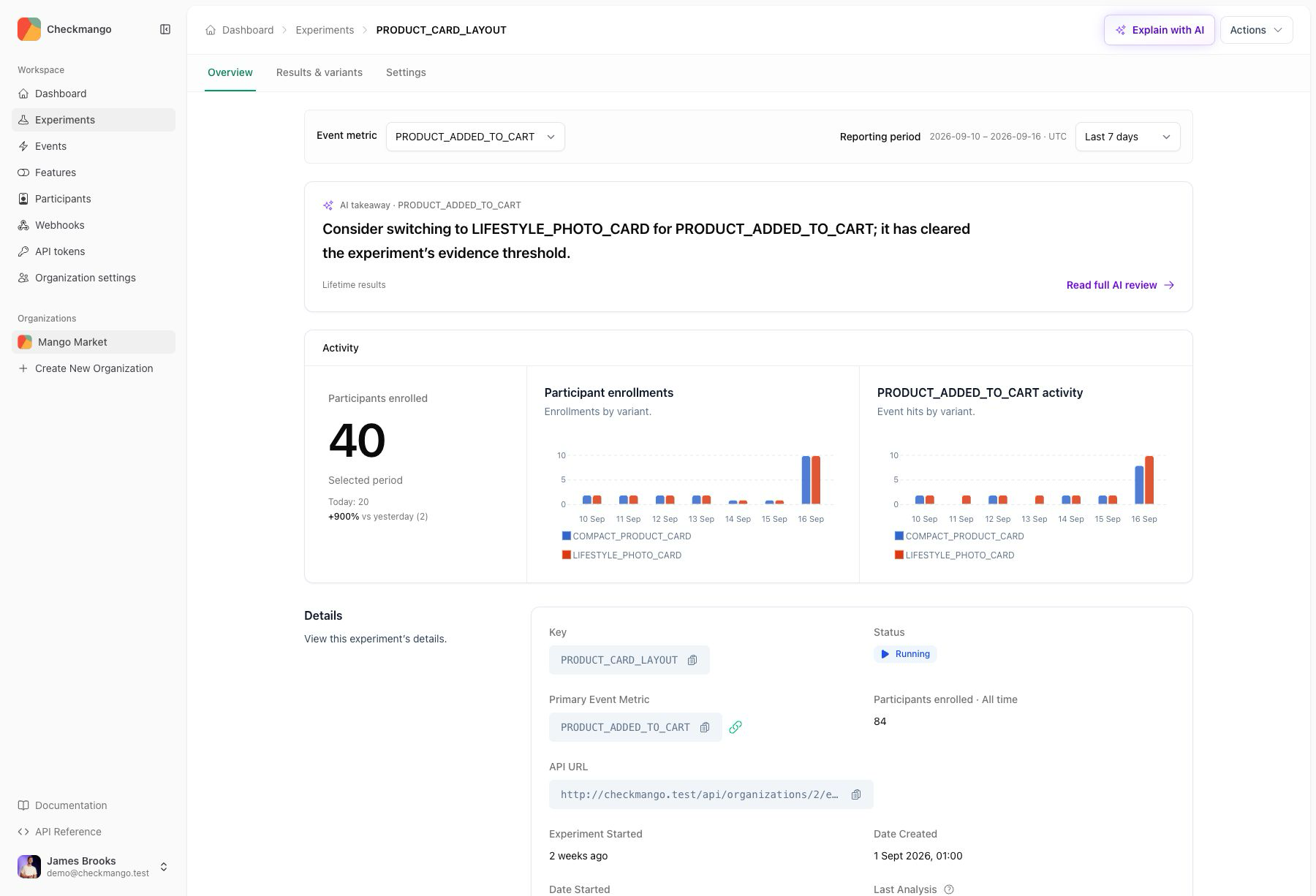
Calling a winner too soon.
An early lead can disappear as more participants arrive. Set expectations for the sample size and duration before the test starts, and account for normal changes in traffic across the week.
Monitor the experiment for tracking problems, but avoid ending it simply because one variant has pulled ahead. A higher conversion rate on its own doesn’t establish a reliable winner.
Treating one number as the answer.
Look at the size of the difference alongside the statistical evidence. Ask whether the improvement is meaningful for your product, whether tracking stayed consistent, and whether other important outcomes got worse.
A statistical result is evidence for a decision, not a promise that a variant is safe or will perform the same way forever. If the result is inconclusive, say so. That’s more useful than forcing a winner.
Finishing the test and forgetting why.
Record the original hypothesis, what changed, what happened, and what you’ll do next. A result that challenges your assumptions can be just as useful as a clear improvement.
Use that learning to choose the next experiment. When you’re ready to control whether functionality is available, a feature flag can help your application choose which experience to show. The flag controls availability; the experiment provides the comparison.
A five-point preflight.
- A clear hypothesis and focused variants.
- A primary conversion goal tied to the decision.
- Enrollment and event tracking checked.
- A plan for sample size, duration, and review.
- A place to record the result and next step.